

Stone, trees and sky-reaching gardens highlight a legacy of preservation as the Chapel Hill Garden Club marks milestone anniversaries
By James Dupree | Photography By John Michael Simpson
The Chapel Hill Garden Club is celebrating the 30th year of its biennial Chapel Hill Garden Tour this spring, as well as the 95th anniversary of the club’s founding in 1931. The event has showcased exceptional public and private gardens throughout Chapel Hill since 1996, and the April 25–26 offering follows suit with seven properties and a theme of Sculpted & Soaring Skyward. “It reflects the incredible history and molding of the exquisite gardens among majestic and sometimes grand specimen trees,” says tour chair Margit Iwanowicz. “We believe that at the core of our gardens are the grounding presence of stone, the shelter of trees and the beauty of nature.”
Dedication to Preservation
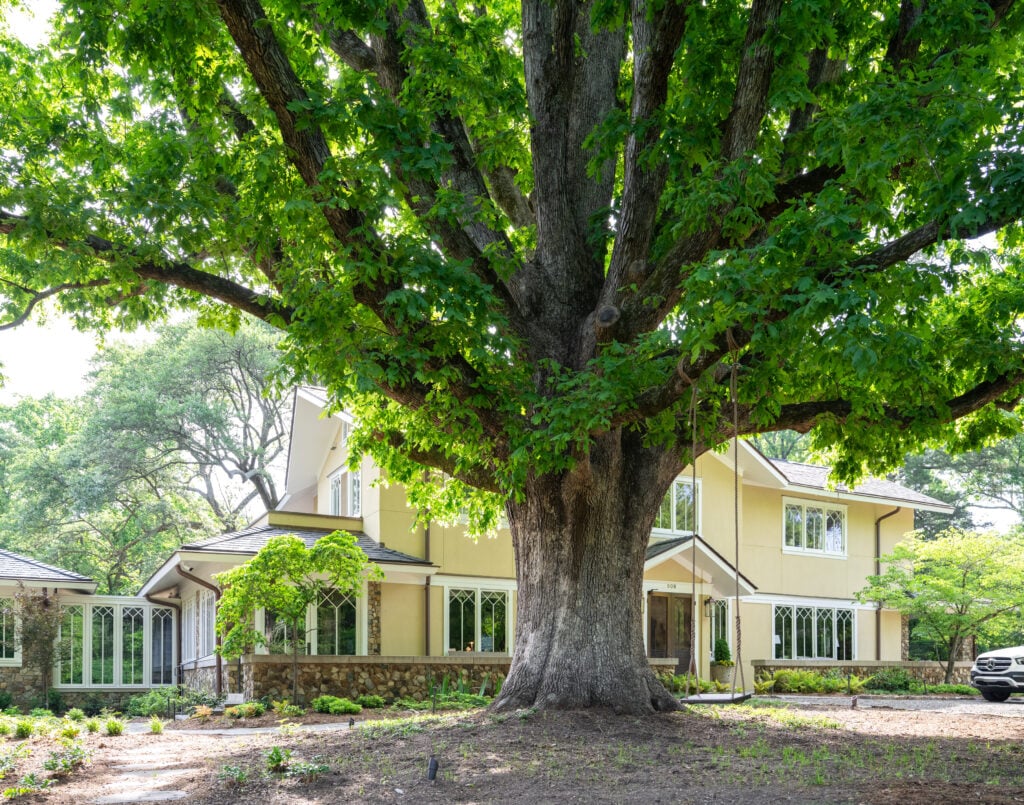
North of UNC’s campus and a block from the Horace Williams House sits a home steeped in rich Chapel Hill history. In 2021, Susan Allison and Ritch Allison bought the historic home of William C. Coker, a professor of botany at UNC in the early 1900s. The inside of the house has 32 easements on it with the state of North Carolina and also has restrictions on the land. “[In] some places the North Carolina Botanical Garden has a say on what work can be done,” Susan says. “You can’t live here and not be dedicated to preserving the land.”
While originally from Charlotte, Susan and Ritch are both graduates of UNC and always planned to retire here. “We are living our dream,” Susan says. However, before moving in, the couple spent three years renovating the house and property, carefully preserving the historical elements while reviving lost pieces of the past. Built in 1908, the house was originally the farmhouse for 65 acres of farmland. Much of the land has been sold following the deaths of William in 1953, and 30 years later, his wife, Louise Coker, in 1983. Susan and Ritch are only the third owners after Walter Woodrow Burns Jr. and his wife, Mary Jane Stratton Mayhew Burns bought the home in 1986. “Mary Jane was the one who really researched what the land looked like when Dr. Coker lived here,” Susan says. “She so loved this property and took many notes about the plant life. Some notes would end with three exclamation marks because she would be so excited about the species she discovered.”
As a botanist, William treated the land like a personal laboratory, planting specimens over the years for study and observation. “We’ve had neighbors talk about how Dr. Coker would go to their homes and plant things as a gift,” Susan says. Now, she tends her own experimental plot — the vegetable garden. It includes sunflowers along with vegetables like cucumbers, okra, watermelon, carrots and lettuce. A fig tree in the backyard, planted by William, still thrives.
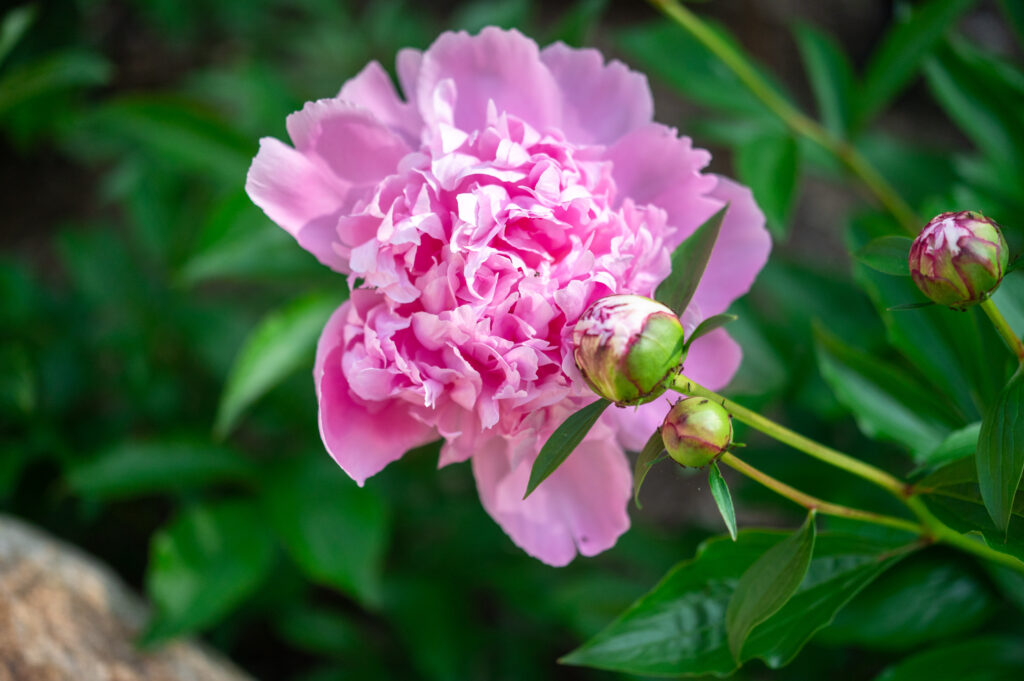
The garden bed on the northern side of the house is all new. “The terrace wasn’t here, and the driveway used to run through where the garage is now and connected to the back driveway,” Susan says. What was once a sloped, poorly drained area has been transformed by installing a French drainage system and permeable pavers to manage the water. The rain garden was recreated to resemble what was originally there. “During construction, we had to remove everything, but we preserved several plants – including Mary Jane’s peonies – by storing them in a greenhouse for two years,” Susan explains.
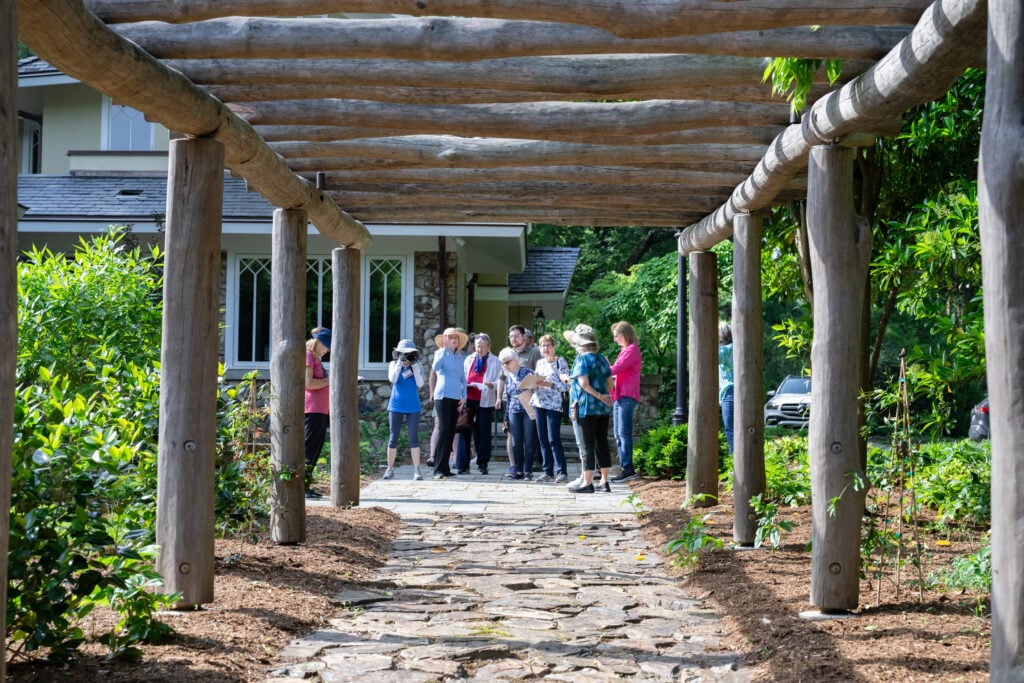
While the new beds and rain garden reflect thoughtful restoration, another meaningful feature has also been brought back to life: the arbor, a prototype for the Coker Arboretum on campus. Years ago the arbor had weakened over time and collapsed, but the original stone pathway remained. Using photos of the original structure, and with the help of landscape architect David Swanson, Susan and Ritch were able to recreate the arbor using timbers made from black walnut, a notably stronger wood. “[David] is known for his historic recreation and preservation of history,” Susan says. “He was really instrumental in constructing it.” Lining the side of the arbor are 100-year-old camellias also planted by William.
Other historical remnants from the original farm have been carefully preserved and thoughtfully integrated into the landscape. Four millstones now serve decorative and functional roles throughout the property – one has been repurposed as a fountain in the front of the property, another acts as the centerpiece of Susan’s vegetable garden, a third anchors the rock garden in the front yard, and the last rests beside a cedar tree in the side yard. Also located near the latter is the farm’s original hand-dug well. The well was preserved at the request of the Town of Chapel Hill, with the couple installing a custom cover that provides a clear view into the stone interior. At night, the well is illuminated, offering a striking view to the bottom measuring 65 feet deep.
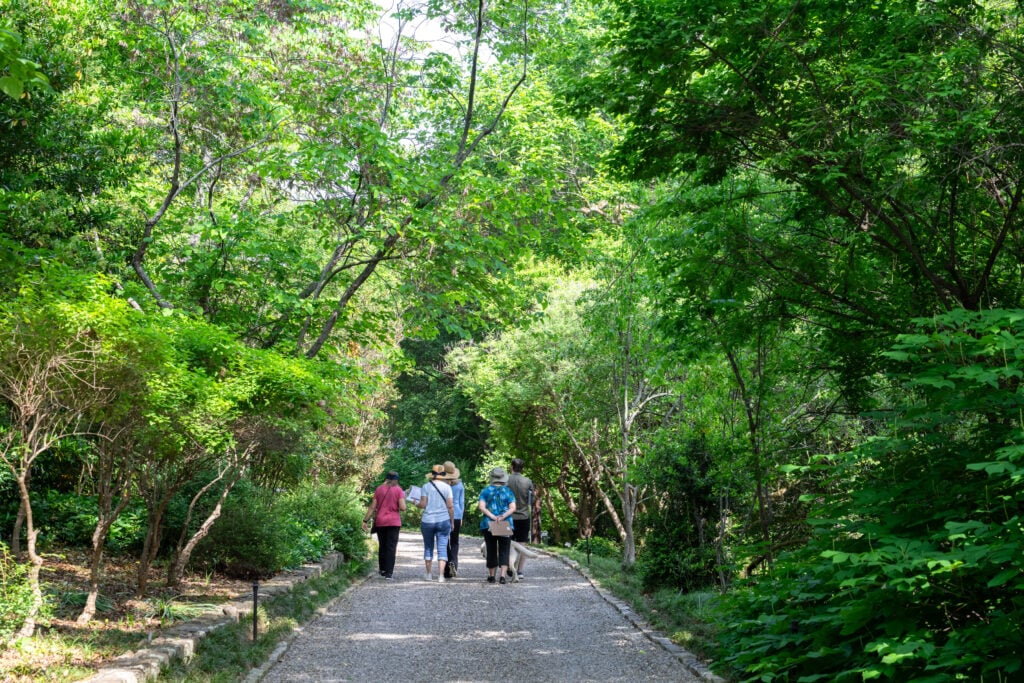
The trail leading into the wooded area facing North Street known as The Rocks, named for its distinctive rock formations, falls under the jurisdiction of the Botanical Garden, which holds an easement on the land. “They’ve helped us clear things out,” Susan says. “They’ll point out the natives and tell us what invasive plants to remove and what not to touch.” The path is well-trodden, with visitors, many of whom are students, passing through daily. A bench sits at the top of a hill surrounded by massive boulders and a plaque tribute to Louise Coker. “People say this rock has healing properties,” Susan says about a boulder jutting out at an angle. “Students will come and lie down on it and say they can feel a positive energy here.”
Up On Rocky Ridge
Tucked into the Rocky Ridge Farm National Register District, a 1928 Elizabethan Revival-style home was designed by Durham architect George Watts Carr Sr. for one of William Coker’s students, John Couch. After earning his Ph.D. under William, John spent his career teaching botany at UNC. The home was a longtime residence for John and his wife, Else Dorothy Ruprecht, set on a lot bordered by a low fieldstone wall. “After that, his daughter, Sally Louise Couch Gooder, lived in the home,” says current homeowner Sara Gourley.
Sara and her husband, Rob Euler, became the home’s third owners in 2015 and took on what turned out to be a major restoration. “We did extensive renovations that took three years due to sewer issues,” she says. “We also added a new garage and dining porch. We did a lot with the garden with the help of David Swanson and Rick King. We have been working extensively on this for the last five or six years.”
The property has 55 mature trees, mostly white oaks, red maples, magnolias, a hickory tree and some southern red oaks. “We have some mature specimens of some odd things,” Sara says, “like eastern red cedars, parsley hawthorn, red buckeye, a Georgia oak, a bunch of Japanese maples and a lot of camellias.”
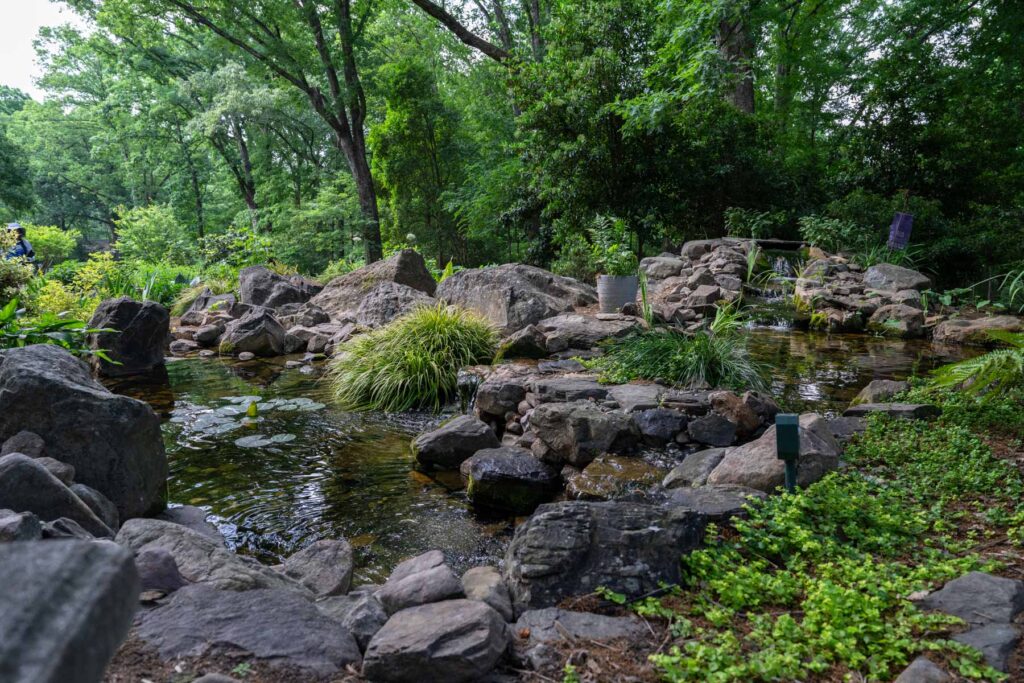
Toward the back of the property, where a dense wall of 7-foot-tall juniper once blocked the view, a new pond garden was created. “You couldn’t even see the bottom of the property from the front because of the junipers,” Sara says. “The first thing we did was rip those out.” The garden is filled with vibrant lilies, baptisia, purple sage, lavender, hydrangea and allium. “The coolest plant is that mayapple,” Sara says, pointing to a stem full of unusual purple blooms hanging underneath the dark green foliage. Amid all of this variety is a surprisingly hardy agave. “It’s survived all these winters,” she says. “We never have to cover it.”
Across the path from the pond, another garden bed bursts with color. Sara’s favorite flowers, the peonies, relish in the sun and Zephirine Drouhin roses climb halfway across the pergola, while a clematis vine shows off its purple blooms. There’s milkweed, common flax, golden Alexander, a red bee balm that lights up in July, goldenrod, salvia, primrose and lanceleaf coreopsis.
At the bottom corner of the property near the street, Sara has carved out what she calls “bee heaven.” Here, sedge grass frames a bed of rattlesnake master, mountain mint, spicebush, elderberry and layers of goldenrod. A tulip poplar sprang up on its own, and joe-pye weed stands tall in the back. From there, a trail was created, winding through a wooded garden with lots of shade-loving plants, including sweet woodruff, Solomon’s seal, star anise and ligularia.
Along the property’s edge, the original fieldstone border wall had started to crumble, so the couple hired Custom Stone to preserve its historic look. “They took all of the stone out, put some concrete blocks down and then built the original stone back over the top,” Sara says. “So it’s new on the inside but very old on the outside.
“This is called Rocky Ridge for a reason,” Sara says about the hulking boulders that litter her property, unearthed like fossils. While geology may not be her area of expertise, Sara and fellow club member Daphne McLeod have been researching the area. “We’re thinking it has to do with the movement of tectonic plates, which would make these boulders millions of years old,” she says. Daphne adds, “What probably happened is when the plates moved, these rocks got pushed up and then erosion exposed these rock layers.”
Sara and Rob enjoy spending time observing their gardens from one of their four porch areas. “They each have different views,” Sara says. “[We enjoy] the smaller green garden in the back to watch the bird feeder on our ‘breezeway’ porch; the forest garden from the screened porch off of our bedroom; the front porch rocking chairs for the ‘vista’ view of the front gardens and yard; and of course, the pergola where it is fun to have cocktails when the mosquitoes aren’t biting!”
With Water Comes Life
For Kevin Ann Huckshorn and Noel Mazade, the christening of their new home started with a pond. Kevin has made a tradition of designing ponds for each new place she calls home, starting in 1990 in Fort Lauderdale, Florida. “I always like to join the local wildlife habitat and get my property certified,” Kevin says. “But first you have to have a water source.”
In September 2015, Kevin and Noel bought a 2-acre property just north of Briar Chapel. Though Kevin had not previously lived in North Carolina, her husband, Noel, had held his first academic appointment at UNC more than 50 years earlier. “I’d always thought the climate in North Carolina was more conducive to gardening than either the Deep South or the North,” Kevin explains.
The land surrounding the couple’s new Chapel Hill home had once been an old tobacco field, but Kevin quickly got to work establishing a water source. She designed the shape of the pond and hired American Aquascapes to do the install, which was completed in just three days.
A few years later, she collaborated with them again to expand the waterway, adding a narrow creek that connects the original pond to a new, smaller one.
Large stones border both ponds and the creek, as well as mulched garden beds hosting a wide variety of plants, including lupine, black-eyed Susan, yellowblooming sedum, aromatic aster and a soft touch Japanese holly, to name a few. Above the gentle stream of water is a garden sign reading “Kevin’s Kreek,” a cheeky gift from a neighbor. On the north end of the property is a thriving community garden. “The first garden I tried to put in back in 2015 had been eaten by the deer,” Kevin says. “And no one in the neighborhood could grow anything because of the deer either.” So in 2016, the couple carved out a roughly 180-by-40 section of land and enclosed it with fencing. The garden now includes around 40 raised beds, tended by 10 of their neighbors. Everyone pitches in and shares the harvest that includes strawberries, asparagus, peppers, herbs and an abundance of cutting flowers. There’s even a fig tree rooted near the edge.
Garden Environments was instrumental in shaping the landscape into the serene retreat it is today. They installed the gravel paths that wind gracefully around the ponds, giving visitors the feel of walking through a botanical garden. From the back deck, one can take in the beautiful view of the wildflower meadow, filled with native grasses and flowers like Jacob Cline bee balm, blue false indigo, lemongrass, prickly pear, coneflower, lyreleaf sage, verbena, foxglove, red hot poker and more.
But the meadow wasn’t an easy victory. “I spent four years throwing seed around and nothing came up,” Kevin recalls. “I was so frustrated because I’d read all these books, but the weeds would take over before anything could germinate.” Kevin had envisioned a pollinator meadow, knowing the area above the septic field couldn’t support deep-rooted plantings. But it wasn’t until Garden Environments came back in 2017 that progress truly began. “I could not have done the pollinator meadow without them,” she says.
All of this makes for a picture-perfect view from the back deck – so perfect, in fact, that Kevin and Noel used the spot as the ceremony site for their wedding in 2018.