
Amanda Bennett, Carrboro’s ninth poet laureate, discusses poetry as a civic practice, Black feminist thought and uplifting the South’s next generation of voices
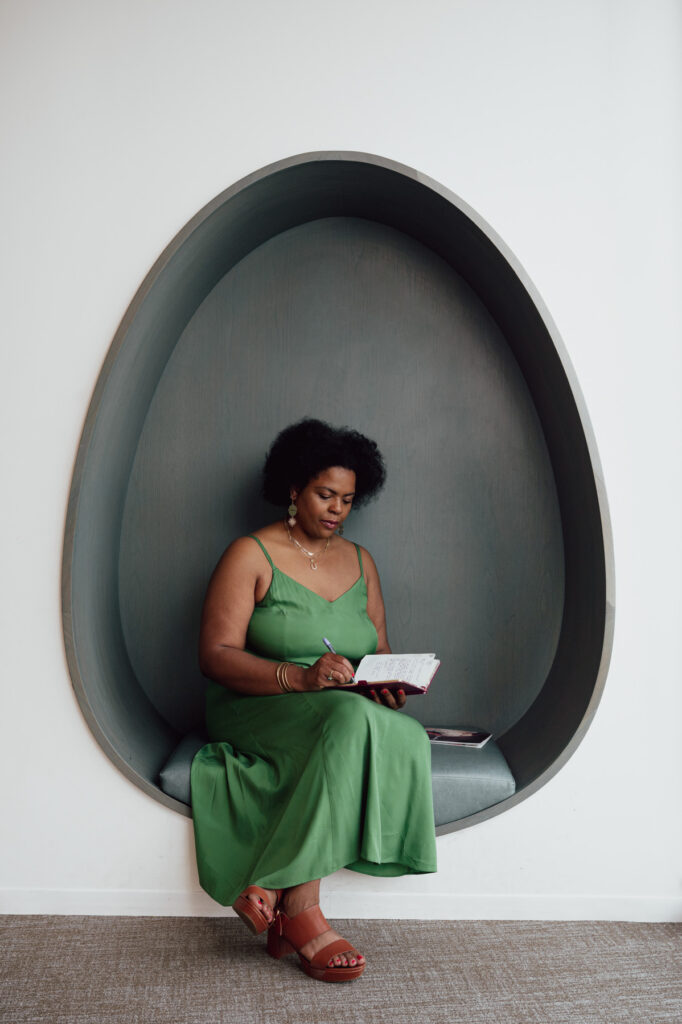
Photography by John Michael Simpson
Poet, public humanities practitioner, cultural critic and Black feminist thought scholar Amanda Bennett was named Carrboro’s ninth poet laureate in December 2025, becoming the first Black woman to hold the role. The Atlanta, Georgia, native earned her undergraduate degree from The University of Alabama and holds a doctorate in literature from Duke. She now resides in Carrboro and serves as a postdoctoral fellow in grant operations management and creative engagement at UNC’s Arts & Humanities Grant Studio. We sat down with Amanda to discuss poetry as a civic practice, the influence of Black feminist thought in her work and her commitment to uplifting the South’s next generation of voices.
What does it mean to be selected as Carrboro’s poet laureate and to be the first Black woman to hold this role?*
I view it as an incredible honor to be chosen by my community to be the voice that shapes culture and literature and helps to establish a stronger relationship between poetry and civic practice. In a time when dialogue is so difficult to sustain between people of different backgrounds, it’s a beautiful responsibility. As the first Black woman, I don’t take that lightly. I recognize that for many young women of color in our community, I become a representation of what’s possible when you lean into creativity and choose not to shrink yourself. How do I conduct myself with integrity and encourage those voices who should come after me? As a woman, particularly a Black woman, the way that I engage with poetry is deeply emotional, deeply relational and soft. To be able to show that is a valid way of being in civic space and of inhabiting poetry is very important to me.
When did poetry first become a practice or passion for you, and what roles has poetry played in your life?
I always had poetry as a meditative practice, even in childhood. It was a way of processing things that were happening around me … and the practice of learning to give language to things that I was feeling. That was happening in isolation, but as I grew older and got more into the poetry community, I began to use poetry as a relational practice of how I convey the inner world inside of me such that it can intertwine with those of other people. I don’t have an MFA, so I came up in the Durham poetry scene, where we would have poetry workshops in someone’s backyard. We’d have a big pot of vegan chili and just share poems back and forth for hours, check in on each other and collaborate on events. For me, poetry has always been a way of finding community and finding mirrors of myself that are meaningful and inspiring.
Your work often centers care, healing, testimony and collective imagination. What draws you to those themes?
Those themes are grounded in my training in Black feminist literature and Black women’s community history. The sisterhood was a group that featured Toni Morrison, Alice Walker, June Jordan and Ntozake Shange. This was when they were writing their famous novels like “The Color Purple” and “Song of Solomon,” but they were not just writing together – they were also pooling money for child care, food and housing. It taught me that literature and writing are actually ways to build a world for yourself and the people who you love. These themes of care, healing and testimony, and collective imagination are actually the scaffolding that makes that world possible.
In my work with poetry as a civic practice in Carrboro, I think about how to create more positive feedback loops, specifically for young girls. So often in our society, a young girl is brave and speaks and puts herself out there, and then is dismissed, minimized and told, “Don’t dream that big.” So she begins to quiet herself. But what if we had a positive feedback loop where when a girl writes a rave poem, the poet laureate is a woman who sees her and, like I did last night, gets to read her poem at a town council meeting? Now the adults who make decisions are hearing her voice, and that then shapes how this woman engages in relationships, how she chooses to mother and how she chooses to show up in her community and at her job. It’s really me trying to lay the groundwork for a more holistically accepting society that is built around empowered women who know how to use their voices strategically.
You’ve hosted poetry workshops and open mics across North Carolina for years. What have those community spaces taught you about the power of poetry?
Even though poetry is thought of as a performative genre, people are actually craving spaces to be in community with each other without the pressure to perform. [For example], at the Women’s History Month poetry reading I hosted with the previous poet laureate, Liza Wolff-Francis, we had students of color from UNC there reading poetry alongside 88-year-old women who have been in Carrboro for decades. They all had the same refrain of, “I felt so seen, I felt so held, and I want to give what I have to make this space sustainable.” The practice of being in community around poetry actually trains people to awaken that instinct that they have within themselves to create spaces that are both generative and sustainable. They can then take that experience and put it into other areas of their lives.
You’ve spoken about uplifting young and marginalized voices. What does that look like in practice during your term?
I have an initiative called Black Girl Dreaming. I’m partnering with the Center for the Study of the American South as well as other organizations in the community to hold workshops that center around both grant writing and life design from a Black feminist lens. We’re leading with our values and also teaching integration to young women and nonbinary folks – mostly of color, but all are welcome – in thinking about how to use poetry as an imaginative tool to design their lives in the way they want and then develop public humanities projects that serve their community from that same place of integration and wholeness. I also judge poetry contests for K-12 students. So once I’m able to meet these amazing young poets and read their work [through Black Girl Dreaming], I can then direct them to these contests I’m judging to be able to elevate their voices.
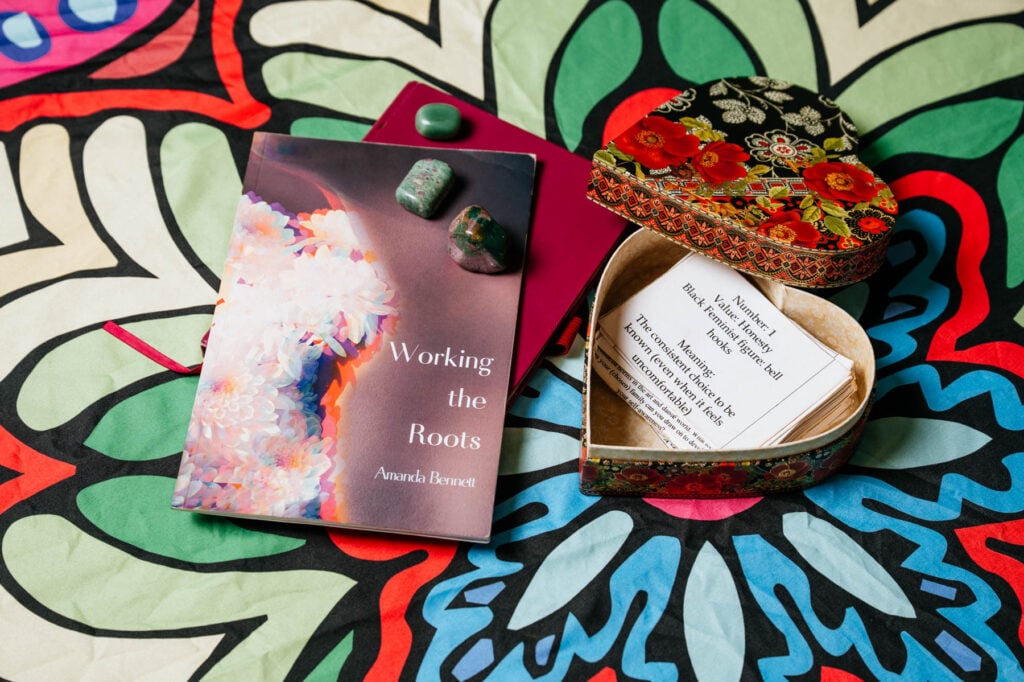
Your poetry book, “Working the Roots,” was published last year. What inspired the collection, and what do you hope readers take from it?
I wrote this book in my 20s around the time of my Saturn return, [an astrological event that first occurs in your late 20s, known as one’s “cosmic coming of age”], when you have these big reckonings with identity, background, faith, lineage, [etcetera]. I was drawn to the intersection of root work within Black Southern cosmology, [meaning your worldview or like an internal operating system that determines how you interpret the world around you]. It’s the idea of being able to create other frameworks of knowing that validate your experience and connecting that with the idea of the root chakra – your foundation, your home, the essence of who you are. If you’re able to process what you’ve experienced and create cosmology that reflects who you are and who you want to be, you’re actually going to feel much more at home within yourself and able to create a much more stable foundation as you age throughout life. I hope that readers take from the book that practice of being willing to look deeply, intimately, critically, compassionately at yourself and the forces that shape you and your people, and choose what you want to take from that going forward so that you can be of better service in your community.
You also write a Substack called Woo in the Real World. How does that platform allow you to explore ideas that may not appear in your poetry?
I’m able to give context to the ideas coming out in the poetry. For example, I can do a long, deep dive into Zora Neale Hurston’s “Their Eyes Were Watching God,” and explain the process of letting go as a liberatory practice. Or I can do deeper dives into how to read tarot as a way to interpret symbols in your own life, and then the poetry is more so me doing that in action. If people want to understand how I got to those conclusions in the poetry, they can read the essays and listen to [my companion] podcast. It’s like showing my work.
You’ve also created other initiatives like Poetry as Pedagogy and the Black Feminist Summer School through your consulting collective, define&empower. You seem to have so much energy – where does that come from?
It comes from a sense of integration. So often in our lives, we’ve had to compartmentalize work over here, home over here, school over here. But through this theoretical framework that I’ve developed called confessionalist rootwork, you’re actually meant to see the threads between all of them so you’re not burnt out by running from one thing to the next. You’re actually building an ecosystem for yourself where everything you do actually feeds your purpose, which then gives you the energy to do these things that you actually care about.
Carrboro has a long tradition of grassroots arts culture. What excites you most about helping sustain and grow that culture?
The possibility of centering the South as a model for the production and support of the next generation of writers. MFAs and [writers’] retreats are inaccessible to the vast majority of people. The idea of being able to be a poet laureate who has civic access and support to be able to offer spaces in which to learn and think together for free is really affirming and exciting to me. You can be a 16-year-old girl in a small town in North Carolina and still be able to get a world-class experience in how to become a writer and how to be in community.
Looking ahead, what are you most excited to create, share or build during your time as Carrboro’s poet laureate?
I’m most interested in cultivating retreats for writers of color. I’ve been working with Danita Mason-Hogans, who is a brilliant historian, cultural critic and community leader in the Chapel Hill area. She introduced me to this idea of narrative justice along with historical witnesses. She’s particularly talking about the experiences of working-class Black folks in Chapel Hill who worked at UNC and may be remembered to some as just a maid, but to the Black community, she was a church mother or a leader in the community. Narrative justice is a way to restore the dignity and humanity of people who might otherwise be erased through bringing in the narratives of historical witnesses who are the children of those people who were erased. Sometimes history and these conversations can seem very inaccessible because they’re either so far away or the jargon is too much. But to have someone who you know and love and you’re connected to, saying, “Here’s the story of our people in a way that is just and full of integrity. I want to share this with you” – I think that’s revolutionary. – as told to Sharon Kinsella
*Responses have been edited for length and clarity
Laureate of Awe
You, who were born for the Word
destined for seeing
what no one else was willing to bear
and still
to cherish
and still
to love
You, architect of desire
living luxuriously
in cathedrals
of yearning
chiseled in loneliness
that cry in the dark
striking
bold as a match
on hostile surfaces.
You are no stranger to grit.
You, laureate of wonder:
clasp destiny so gently it remembers
its wings.
War is not your duty.
Nor kings.
Nor greed.
Nor the blood-tipped follies
of hubris.
Reclaim your sight
here,
in this coven of tenderness.
Do not lay waste
to the mundane.
The miracle of love
reveals itself
in quick corners
moving too swift
unless awe
is your only eye.
– by Amanda Bennett