
New superintendent Rodney Trice reflects on his journey, priorities and goals for Chapel Hill-Carrboro City Schools
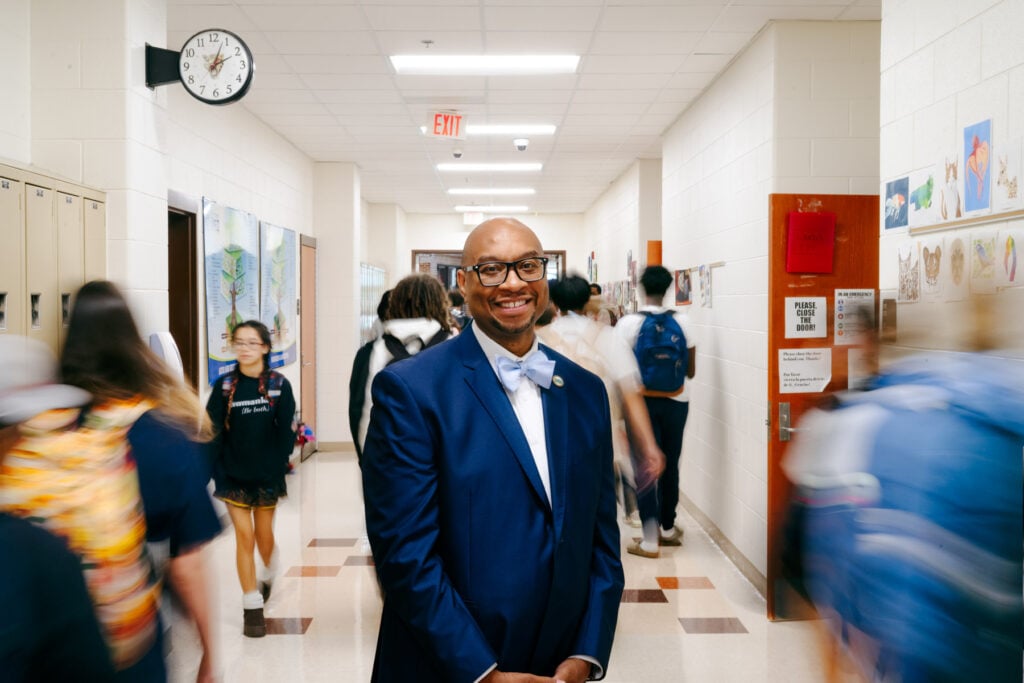
Rodney Trice officially stepped into his role as superintendent of Chapel Hill-Carrboro City Schools this July after three years as deputy superintendent for teaching and learning and more than a decade of leadership in the district. He and his wife, Dr. Kenya McNeal-Trice, moved to Chapel Hill in 2002 from Detroit, Michigan, for Kenya’s medical residency at UNC Children’s Hospital and Rodney’s doctorate in educational leadership at UNC. He has since built a career focused on equity, leadership and student success, holding senior roles in both the Wake County and Chapel Hill-Carrboro public school systems. A parent of two daughters who have come through the district – Zuri, now a junior at UNC, and Sala, a sophomore at East Chapel Hill High School – Rodney brings both professional expertise and personal perspective to the job. We sat down with Rodney to discuss his path to the superintendency, his passion for equity and education and his vision for the next 25 years.
*Responses have been edited for length and clarity
What motivated you to become an educator and eventually superintendent?* My undergraduate degree was in biology, so I always saw myself working in a lab after graduating. I had a special interest in immunology, but because my wife was in medical school [and wasn’t working], I had to work. I started teaching science at Detroit Community High School on the west side of Detroit and fell in love with teaching. The rest is kind of history. I put away the idea of working in a lab by [myself]. Working with other teachers really appealed to me and, of course, interacting with students and families. Although I had come from a family of educators – both my mom and dad were longtime teachers – I always grew up saying, “I’m not going to be a teacher.” … But once [I got] into the classroom, and I really [understood] the impact that [I could] have on students and families, and as [I began] to see my students matriculate and graduate – it was just a totally different experience. I just fell in love with education, and I was off to the races. I switched my graduate studies from science to education at that time.
Tell us about an educator who made an impact on you growing up. I had an interest in science from a very early age. It was in middle school [when] that deepened, and I think it’s because of the science teachers that I had – [they] really took that to another level. My sixth and seventh grade science teacher, Miss Davis, was one of the first to acknowledge verbally that I might have a skill set in that space. That was very affirming. [That’s where it really took off. … My eighth grade science teacher, Mr. Croom, was also very instrumental. He was a bit more serious about science in terms of what it could do for society and individuals. He was the one who began to talk to us about genetics and diseases and thinking more deeply about science. What’s unusual is that both of them were African American teachers. When I became a teacher, even at my school in Detroit, most of our science teachers were white or other races. [There weren’t] very many African American science teachers. I’m sure that also played a part in [it]. If you see someone who is doing what you love and modeling that, [you think], “I could probably do science as well.”
Did you do any extracurriculars in high school? I did photography. That’s something that is still with me. I have a ton of camera equipment. That’s going to be my retirement profession. I ran track and played basketball – did varsity on both of those. I had some college recruitment coming out of high school but ultimately made the decision to pursue science in undergrad.
Tell us about your work in the education equity space, specifically in your role as deputy superintendent for teaching and learning, systemic equity and engagement and other similar ones you’ve held. That really [extends] back to my parents. They always focused on diversity, equity and inclusion in their work as educators from a very early age –certainly before it was a thing in our new terminology. Growing up, I was always involved [in equity work]. I was the president of my youth chapter of the NAACP, which has always been focused on equity and diversity and fighting for social justice. So from a very early age, that was just a part of who I was, a part of my activities. …
We often think about public schools as that institution that levels the playing field for all people, [with] the public aspect of that meaning everyone. I just [happened to come] along when equity and diversity began to have a foothold in institutions. … I’d had a special focus on that since the time I was brought up, but [I was] also very much interested in the teaching and learning aspects of education and marrying those two. The values of public education: diversity, equity and inclusion; [of] being for everyone, irrespective of who you are [or] where you were born – just really interests me.
Prior to my time in Wake County, I don’t think I ever applied for a job that had equity in the title. It always just emerged. Even here in Chapel Hill the first time around – I was first executive director for curriculum and instruction, but [within] that was equity. By the time I became the associate superintendent for student and school services, because of the work that I’d been doing, they decided to add equity oversight to it. Going to Wake [County], they had not had an equity department prior to me arriving, so part of my task was building out what a department or division would look like.
What are the biggest challenges you’re seeing in education right now, and what would it take to overcome those challenges? One [problem] is certainly budget. Since the pandemic, we’ve experienced a decline in enrollment, and there are fiscal pressures because of that, because when you lose students, you lose revenue. Over the past couple of years, that has forced us to make some hard decisions with respect to [organization and] staffing various programs that we’ve had in the district for a very long time. … But some of [those decisions] were important and will create a solid foundation for us to build on.
[In terms of what it takes to address that]: being in continuous conversation with our board and our community about what the challenges are but also being open to using this as an opportunity to reposition ourselves for the future. It doesn’t appear that public education will be getting an influx of funds or anything like that. So, [it’s] working with the community to take a good, close look at ourselves and really thinking about: What do we want to be? What do we want to work toward over the next 25 years? … Our society is changing. There are more opportunities out there for students beyond what we typically think about, like the four-year university track. One of the biggest challenges we face as a community could be complacency as well. We’ve been a very high-performing district. We’re still a high-performing district. But if you look at our graduating cohorts, 30% to 35% of the graduates don’t choose a four-year university to attend. … Making sure opportunity is available to those students is very much top of mind for me as superintendent. We’re going to need our community partners, our university partners, families and caregivers and our board to all get on board with: What do these pathways and opportunities look like [for these students]? … [It’s] very exciting, but it is rooted in a challenge that we’re also facing as a district.
What are your current educational priorities? [The priority is] to maintain the standard of excellence that we’ve come to know and expect in Chapel Hill-Carrboro. That doesn’t just happen [randomly]. There’s a lot of effort put into that. … There are a lot of priorities in [our strategic plan] that we also have to think about and attend to. We’ve made some pretty impressive gains in being able to complete some of the things that we said we wanted to do in our strategic plan, from establishing a regular curriculum adoption in the district, [to] our focus on student wellness and health. Next year [is when] we [will] review our strategic plan and see how close we’ve come to hitting all those marks and [begin] to think about the future.
A local technology plan is something we’ll be focusing on at the beginning of this year with the explosion of AI and just how ubiquitous technology is in our world. It’s kind of forcing us to kind of think about: What are the parameters around technology and how it’s used in our school district [and] also our community? Very early on, we thought so much about how technology benefits us as a society and as a community. But recently, the harmful impacts of technology [and] social media have also been very clear. We’re in a different place than we were five or 10 years ago. That is also a priority for us.
What kind of projects or initiatives are you working on right now as superintendent? Which ones are you most excited about? I started [the work as] deputy superintendent, but now that I’m superintendent, I’m putting a super charge on [building out graduation pathways]. For instance, we’ve doubled enrollment this year for cross enrollment: students being able to take courses at other high schools here within our district. This is the first year that we’ve had college-level Durham Tech courses taught at all of our comprehensive high schools. We’ve more than doubled our enrollment of students who are taking advantage of [that]. These are some of the things that we can see now.
But the one thing that I’m really focused on now is just being more present. As a superintendent, I often say that it’s important to me to make Chapel Hill-Carrboro feel small again – and not small in opportunity but small in community connection. Being able to call the superintendent and say, “This is going on,” and knowing the names of parents and students. … I really believe that all we’ve been talking about is built on top of relationships. I see that as the foundation for building out what we are in the future [and addressing our challenges]. If you’re going to be in the community or asking for its help mapping that out, you have to be open, approachable and willing to listen. There are probably a lot of competing ideas about what it means to be Chapel Hill-Carrboro for the next 25 years, [but] that’s what I’m most excited about – because I do think I have an understanding of the need for that to move us forward as a district.
What do you do for fun outside of work? In season, I like to garden, which is coming to a close quickly – although I have a bet with my youngest daughter that I can grow a watermelon indoors during the winter months. But gardening is where I get my peace. You can just kind of disconnect and go out in the morning before work and pick a couple of weeds or water your vegetables. That grounds me. Also sports – we’re a sports family: Detroit Lions football, University of Michigan football and NBA basketball. I like to read. I like to listen to jazz music. Live music is very important to me and my family. We’ll go to Missy Lane’s in Durham, travel to South Carolina to listen to jazz. … [We see] plays at DPAC. We take advantage of [performances] at [UNC] as well.
What kind of legacy do you hope to leave here? This is my 27th year in education. I want to be known as someone who was a full partner in the education space – willing to get my hands dirty to help problem-solve our community’s and our nation’s challenges, especially around equity. It’s something I think about a lot. I really do believe in the primary mission of public education in terms of being a space for everyone without exclusion, but I want to be known as someone who not only talked about it, but through my work, demonstrated that’s the kind of district that we’re going to have. We’re going to have systems and structures in place that allow for that. … I know what education did for my family. I can see what it’s done for students that I first taught in Detroit who are now parents and have children in school, and I see how it transformed their lives. There’s a promise here in public education that I think is worthy of protecting. That’s what I want to be known for. – as told to Sharon Kinsella